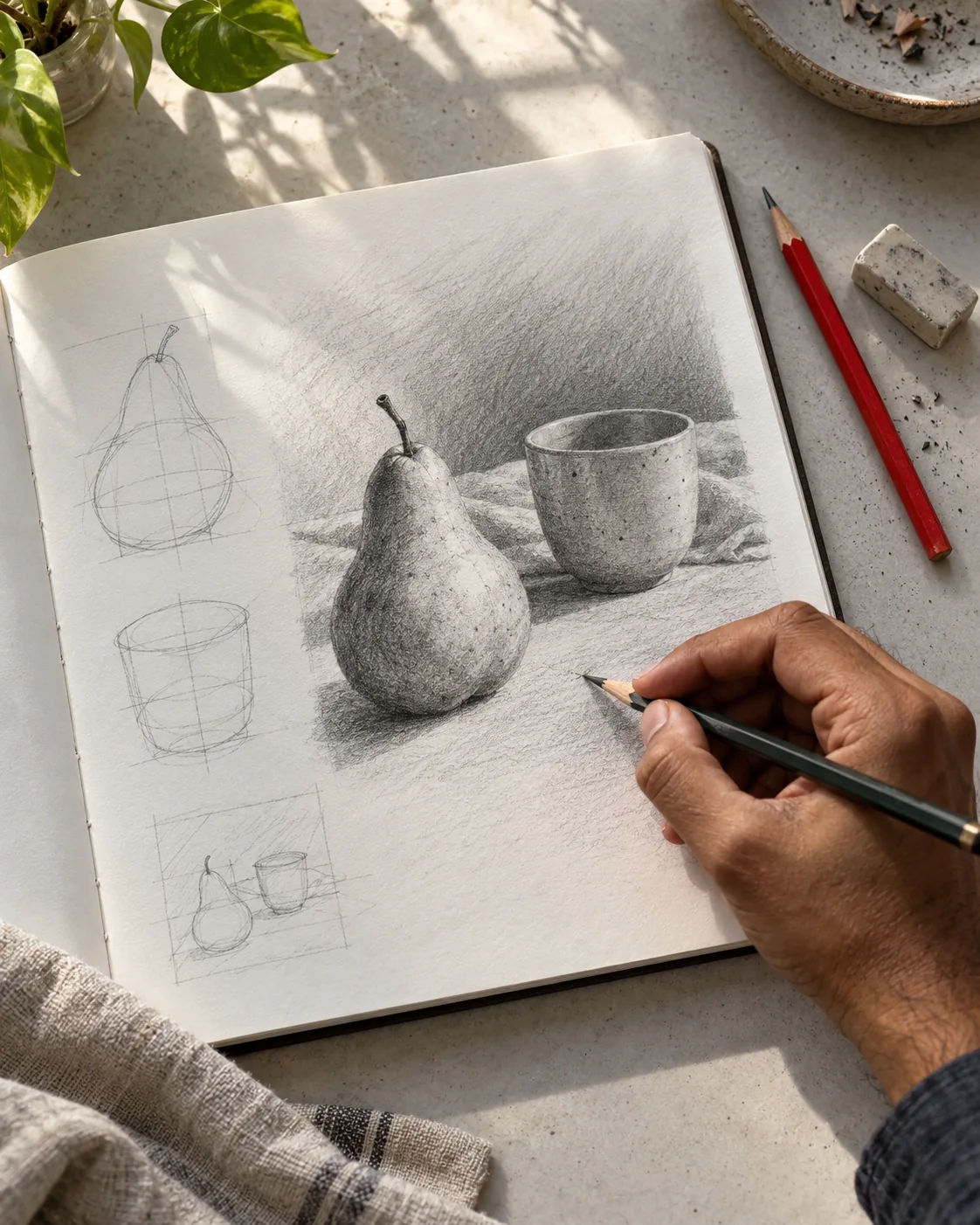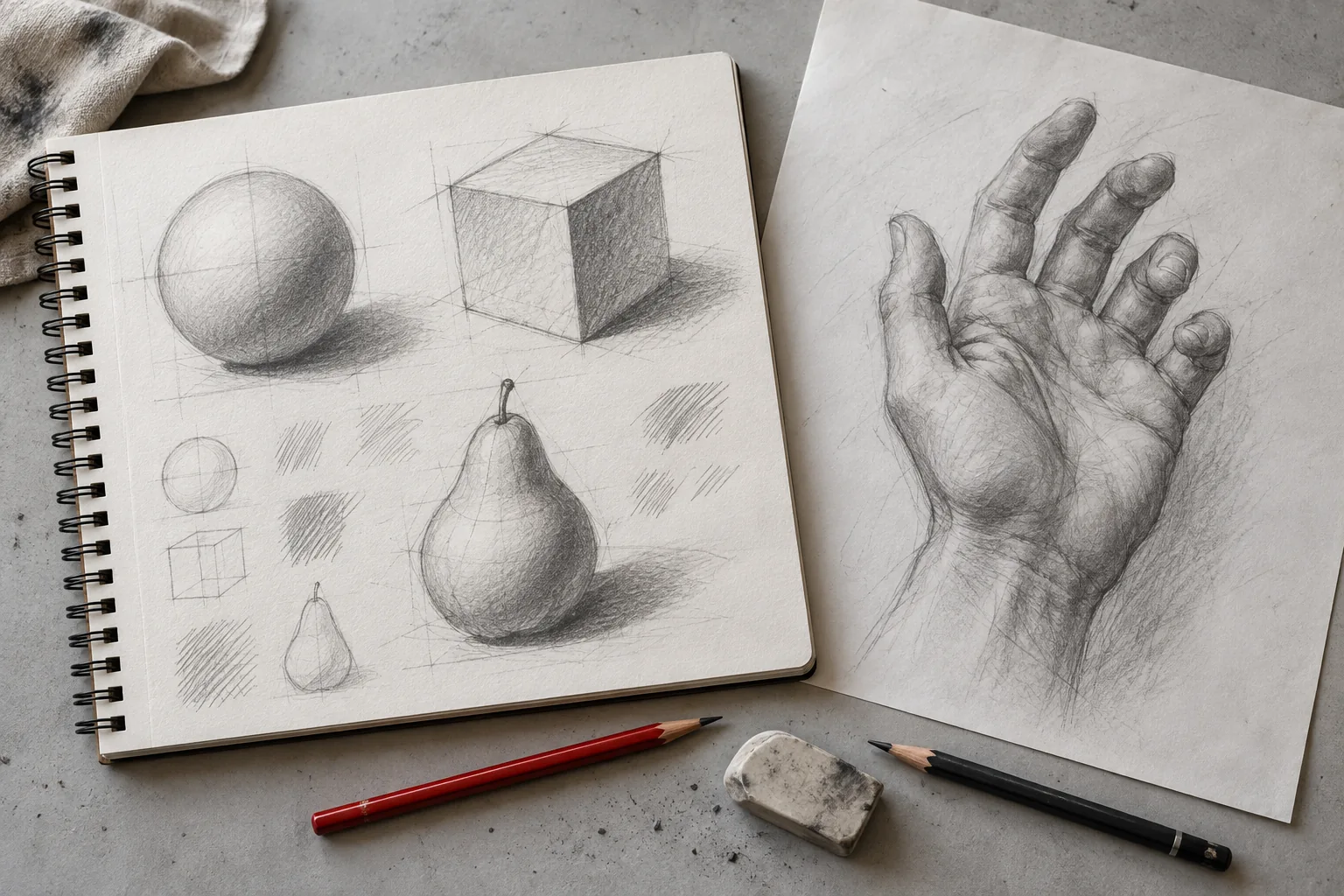
When you are learning drawing alone, it can be difficult to separate a problem in the picture from a problem in your process. A sketch might look awkward, but “something is wrong” does not tell you whether to work on proportion, construction, line control or shading.
Useful feedback narrows that uncertainty. It gives you an observation you can see in the drawing and a suggestion you can try in the next attempt. It is not a substitute for practice, and it does not need to cover every imperfection at once.
Feedback is more than praise or criticism
“Nice drawing” can be encouraging. “The perspective is wrong” can identify a broad area. Neither statement gives a beginner much direction on its own. Useful guidance explains what the comment refers to and why it matters for the exercise.
For example: “The large shapes are clear, but the cup is much taller in your drawing than in the reference. Compare its height and width before adding the handle.” That feedback identifies something working, points to a visible issue and suggests a next action.
This is an illustrative example of teaching guidance, not a claim about a particular learner’s results. Different drawings and learning goals call for different observations.
Show the goal of the exercise
A mentor can be more precise when they know what you intended to practice. A quick gesture sketch should not be judged in the same way as a detailed shaded study. Tell the person reviewing your work which lesson or exercise you attempted.
Include a clear photo with enough light to see the marks. Avoid a strong camera angle that distorts the page. If you used a reference, share it where you have permission and explain which part was difficult. You do not have to present a polished final image to deserve useful guidance.
Instead of “Is this good?”, try a question such as “Have I made the box’s top surface too large?” or “How can I separate the object’s shadow from its outline?”.
Choose one suggestion to work on
A long list of corrections can make the next attempt feel heavier than the first. Start with the observation most relevant to the lesson. If the big proportions are uncertain, correcting tiny textures may not help very much.
Turn the suggestion into an exercise. “Compare the height and width” could become three light outline sketches of the same cup, each checked before details. “Simplify your values” could become a drawing limited to three broad tones.
Write the exercise in your own words. This makes it easier to know when you have actually attempted the feedback rather than merely reread it.
Draw again before asking again
After receiving feedback, make another attempt and keep the earlier drawing nearby. Focus on the chosen correction, even if other parts still feel unfinished. This gives you something specific to compare.
Ask yourself: Did I change the intended relationship? Did I notice the problem earlier? Was the exercise easier to approach? Improvement can include a clearer process even when the final picture is still imperfect.
If the suggestion did not make sense, say which part you could not apply. “I understand that the rim is tilted, but I cannot tell which side to adjust” invites a more useful explanation than another general request for a review.
Keep your own artistic decisions
Feedback should support learning, not make every drawing look like the mentor’s work. Distinguish between a skill you are practicing and a personal choice about style, subject or expression.
It is reasonable to ask why a change is suggested. A correction might make a construction more consistent, or it might be one of several valid choices for the composition. Understanding that difference helps you apply guidance deliberately rather than follow every comment mechanically.
Build feedback into a learning routine
A repeatable loop is simple: learn a skill, attempt it, ask a specific question and use the answer in another drawing. Keep the focus manageable and save the attempts. Over time, the record can help you recognise recurring issues without needing a fresh explanation every time.
NIDAL brings structured lessons and mentor guidance into the same learning journey. Explore how feedback works, or ask the team on WhatsApp about the current way to submit your work. There is no need to wait until a drawing looks finished to identify a useful next step.