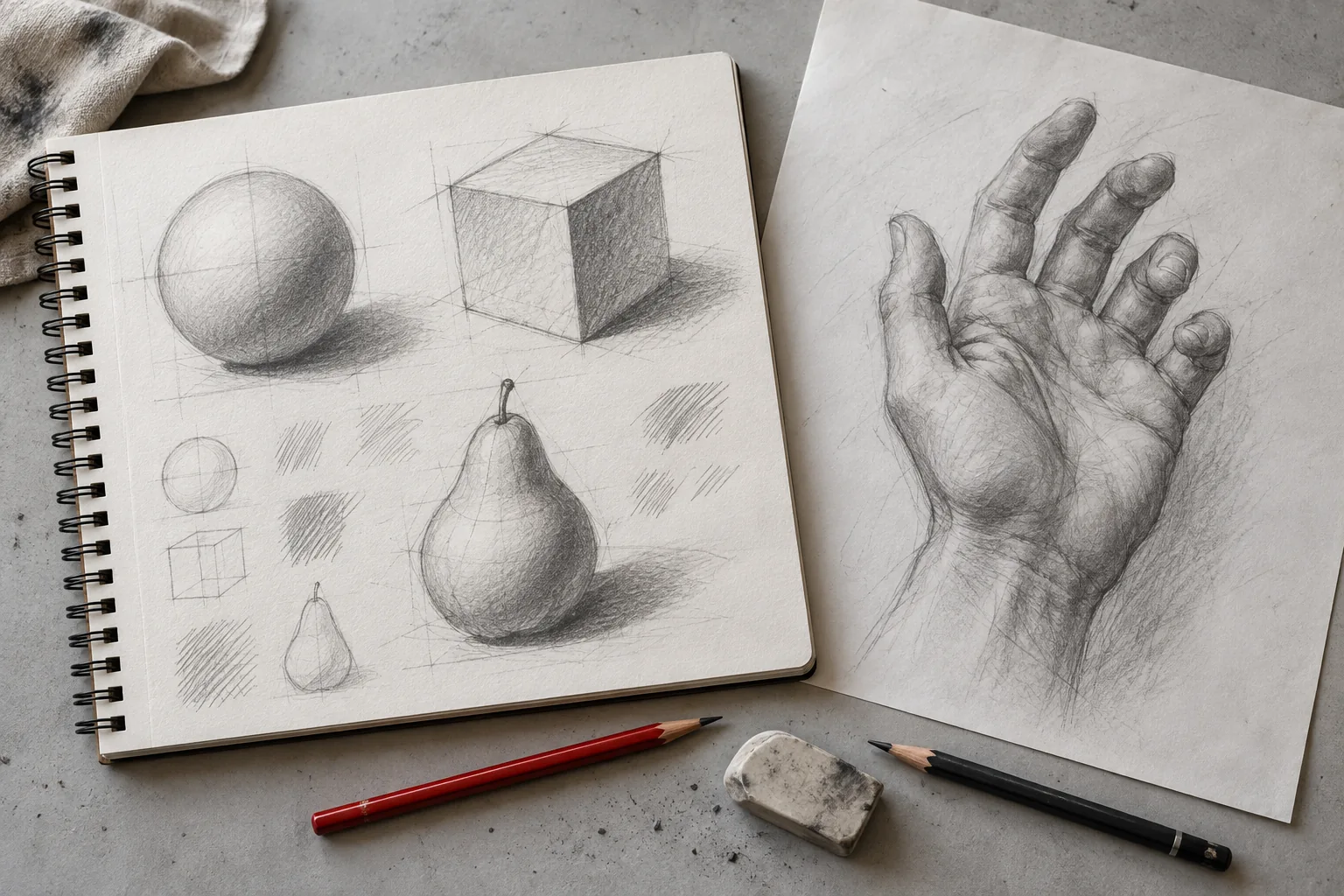
Feedback is useful when you can turn it into a decision. A compliment may encourage you, and a score may summarise an assessment, but neither necessarily explains what to practise next. Constructive critique connects a visible feature of the drawing to a manageable action.
You do not need to ask about every aspect of a sketch at once. Begin with your intention, show the relevant reference where you have permission and identify the part you are unsure about.
Explain what you were trying to do
A quick gesture sketch and a realistic shading study have different aims. Tell the reviewer which kind of work you attempted. Otherwise, advice about detail might distract from the gesture, or expressive marks might be judged by the wrong standard.
Describe the skill you were practising. For example: “I wanted the cup to feel round, but the opening looks wrong.” This makes it easier to discuss ellipse proportion and viewpoint rather than a general judgement about talent.
Ask a specific question
Instead of “Is this good?”, ask “Does the light direction read consistently?” or “Which proportion should I correct first?” A narrow question helps a mentor prioritise. It also gives you a way to evaluate the next version.
Avoid sharing private information alongside the drawing. A clear photograph of the artwork is usually more relevant than personal details. If you are under 18, involve a parent or guardian before joining accounts or sending contact information.
Understand the reason behind a correction
Useful guidance explains why a change matters. If the handle is too large relative to the mug, the correction should connect to the observed proportion. If reflected light is too bright, the explanation should connect to the relationship between light and shadow groups.
Ask for clarification when you do not understand an art term. “Could you show which edge you mean?” is a reasonable follow-up. Feedback should leave the next task clearer, not just add unfamiliar vocabulary.
Choose one priority
You may receive comments about proportions, values and edges. Choose the issue that has the greatest effect on the current study. If construction is incorrect, polishing texture may be premature.
Make a small practice study before revising the whole artwork. Draw five ellipses from the relevant viewpoint, or make a value strip to check the shadow range. A focused exercise reduces the number of decisions competing for attention.
Keep both versions
Save the first sketch, the exercise and the revision. Write down which correction you attempted and whether it became clearer. You do not need to claim a dramatic transformation. A more accurate ellipse is already a meaningful change.
The feedback demonstration on this website is a teaching illustration, not a student result. Use it to understand the process of comparison, not as a promise of your own outcome.
How NIDAL fits
NIDAL combines structured drawing lessons, guided practice and real mentor guidance. Begin in NIDAL Learn or ask the team on WhatsApp for the current submission process. This article does not promise instant replies, unlimited reviews or individual live sessions.
Read the mentor feedback page for the broader approach and shading techniques for a focused exercise. The goal is to finish feedback with an action you can actually try on paper.